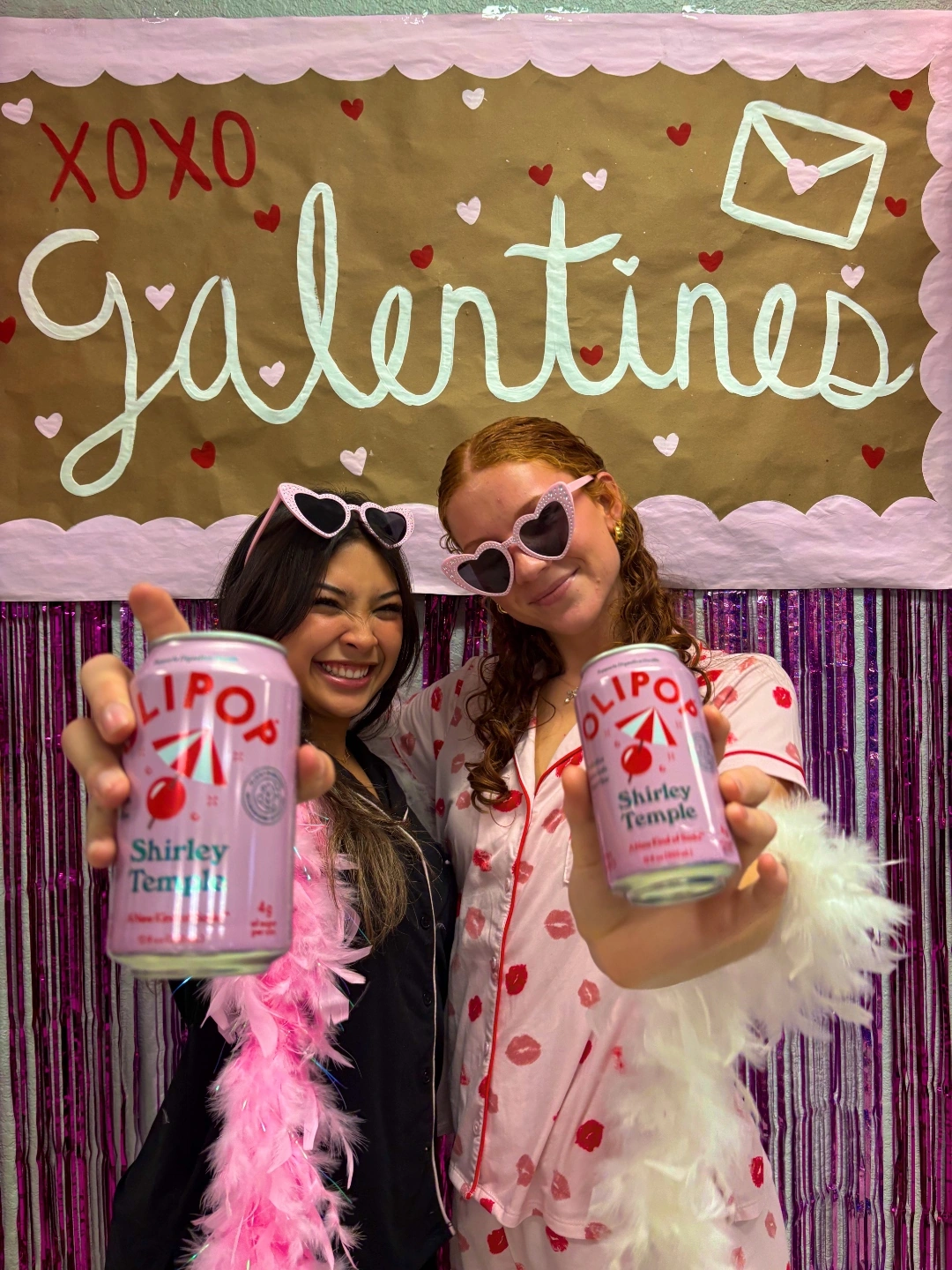
Picture a sorority sleepover on a February night. One of the sisters is an OLIPOP campus Ambassador, and instead of just lining up cans on a table outside the student union, she converts the whole event into a "Galentine's x OLIPOP Shirley Temple" photoshoot. Everyone is in pajamas, passing around pink cans, taking photos around the product. The brand is not sponsoring a moment. It is inside one.
That is product sampling on college campuses at its best, and it does not always look like a folding table and a stack of samples. Sometimes it is tabling between classes. Sometimes it is an Ambassador dropping product at a student org meeting, turning a dorm hangout into a taste test, or building a themed event that friends actually want to attend. The common thread is that the trial happens inside a peer setting where trying something new is social, not transactional.
Compare that to what most CPG brand managers are actually choosing between when they build a trial budget: an endcap in a grocery store, a paid social push, or a line item for campus sampling. Each channel wins on a different metric, and confusing them is where a lot of sampling budgets get wasted.
Why product sampling on college campuses is not retail sampling with a different backdrop
Retail sampling puts a product in front of a shopper who is already standing in the aisle with a cart and a list. That proximity to the register is real and valuable, it is why in-store demos still work. But the shopper trying your product at 4pm on a Saturday next to the chip aisle is not necessarily the shopper you are trying to build a ten-year relationship with. They are whoever walked by.
Campus sampling is a different instrument aimed at a different target. It reaches an audience of 18.4 million-plus college students nationwide, per National Student Clearinghouse Research Center data, during the exact multi-year window when brand preferences get set for the first time without a parent's grocery list attached. It is not trying to close a sale in the next ten minutes. It is trying to plant the first experience a nineteen-year-old has with a product on their own terms, in a peer setting, before that person has locked in the brand habits they will carry for the next decade of grocery runs.
That distinction matters because the two channels answer different questions. Retail sampling answers "will this shopper buy it today." Campus sampling answers "will this future high-earning household put this on the list once they start doing their own shopping." Both are legitimate. They are not the same line item.
The real comparison is cost per quality trial, not cost per sample
Cost per sample is an easy number to chase and a misleading one to optimize for. A sachet handed to someone who tosses it in the trash costs the same as one handed to someone who tries it, talks about it, and posts about it, but the two outcomes are not remotely equivalent. The number that actually matters is cost per quality trial: a sample that gets tried, generates a data point on purchase intent, and ideally produces content that keeps working after the activation ends.
This is where a managed campus Ambassador program earns its cost relative to a cheaper-looking retail demo or a paid social buy. When Sour Punch ran a nationwide campus sampling and social content program with EvolveZ, 52 Ambassadors across 46 campuses distributed more than 40,000 samples, and the program paired that volume with purchase intent measurement rather than just a headcount. Survey results showed 77.6% of students who tried a sample said they were "much more likely" to purchase Sour Punch going forward, and 29% of everyone sampled had never tried the brand before. That is a trial program generating a measurable intent signal at scale, something a retail endcap generally cannot hand a brand manager at all.
The content layer compounds the math further. Sour Punch Ambassadors posted 674 pieces of content across TikTok and Instagram during that program. Five of the top-performing videos were boosted through Spark Ads and generated more than 3 million impressions at approximately $2.40 CPM, well under the $5 to $10 CPM benchmark TikTok shares for impressions-based campaigns in food and beverage. Earned media value alone came in at 4.15 times total program spend, before even counting the value of the 40,000-plus samples distributed. A retail demo does not generate a content library. A cold paid social campaign does not generate a peer-to-peer sampling moment. Campus sampling, run correctly, generates both at once.
Where retail sampling and paid social still make sense
None of this means retail sampling or paid social are the wrong buy, they are the wrong buy for a specific job. A brand launching a new SKU that needs immediate shelf movement in a defined trade area should be running in-store demos tied to point-of-sale data. A brand trying to reach the broadest national audience fast, with no requirement for peer context or a content byproduct, should be in paid social.
The mistake is treating these three channels as interchangeable line items competing for the same dollar based on cost per sample alone. Product sampling on college campuses is the right channel when the brand needs concentrated Gen Z trial, a peer-driven setting that lowers skepticism, first-party purchase intent data, and content the brand can keep using after the semester ends. If a brand does not need all four of those things at once, campus sampling is probably the wrong tool. If it does, nothing else does all four in the same motion.
What a measurable campus sampling program actually tracks
A campus sampling program that is not measuring anything is just a very expensive way to give away product, and that is the gap between a marketplace-style DIY tool and a managed program. Every sample interaction in an EvolveZ program is tied to a QR code that either records a direct sale or routes to a short survey capturing awareness, trial intent, and likelihood to purchase, and those results roll up into a weekly client dashboard alongside CreatorIQ's content performance data. That is the difference between "we handed out 40,000 samples" and "we handed out 40,000 samples and here is what the purchase intent data says about whether they will buy it again."
OLIPOP is the proof point on how that measurement works when the sampling goes beyond tabling. Their EvolveZ program deployed 25 Ambassadors across 24 campuses and distributed more than 50,000 full-size cans through a mix of tabling, student organization drops, Greek partnerships, and five roadshow activations where the OLIPOP team joined Ambassadors on the ground. The Galentine's sorority event is one example of an Ambassador creating an intimate brand moment that a tabling setup alone could not produce. The measurement held up across all of it: 76.1% of sampled students said they were "much more likely" to purchase OLIPOP going forward, and 42% had never tried it before, and the program's opt-in rate for post-sampling retargeting came in well above typical CPG benchmarks, giving OLIPOP a qualified audience to continue marketing to after the semester ended.
What this looks like when it works at scale
Doritos shows what happens when a brand commits to the channel across multiple product cycles. Frito-Lay launched its first campus Ambassador program with EvolveZ in Spring 2024 promoting Doritos Dinamita with 100 Ambassadors, and the partnership has continued for four consecutive semesters since, moving through Doritos Golden Sriracha and Doritos Dinamita XXTRA Flamin' Hot. More than 30 pieces of Ambassador-created content were repurposed onto Doritos Dinamita's own TikTok account. Frito-Lay renewed semester after semester because campus sampling reached a hard-to-reach Gen Z audience in a concentrated setting where word of mouth spreads fast, and because EvolveZ's compliance process ensured every event and social post met brand standards without the brand team managing that risk internally. The 3PL warehouse and weekly reporting meant Frito-Lay was not spending time on logistics or content approvals.
Put all three programs side by side and the pattern holds. Sour Punch reintroduced a candy brand Gen Z remembered from childhood, and 29% of everyone sampled became a first-time trier. OLIPOP introduced a functional beverage category to a generation rethinking what they drink, and 25 Ambassadors turned 50,000 cans into a 76.1% purchase-intent result and a content library performing at nearly 2x the industry benchmark. Doritos needed sustained relevance for new flavor launches across a national college footprint, and four consecutive semesters turned that into a recurring content and trial engine.
None of this shows up on a retail point-of-sale report or in a paid social dashboard that only tracks impressions. It shows up when a brand treats product sampling on college campuses as its own channel with its own KPIs: trial rate, purchase intent lift, content output, and earned media value relative to spend. The same framework is covered in more depth on how sampling builds loyalty over a full campus program, and in how that trial moment gets amplified into social content that keeps working long after the semester ends.
Brands that get this right are not just buying samples. They are buying a repeatable system for turning strangers into future customers, with the data to prove it worked. Submit a request and our CEO, Michael Spitalieri, will turn around a proposal for your program outlining capabilities, deliverables, and pricing.